
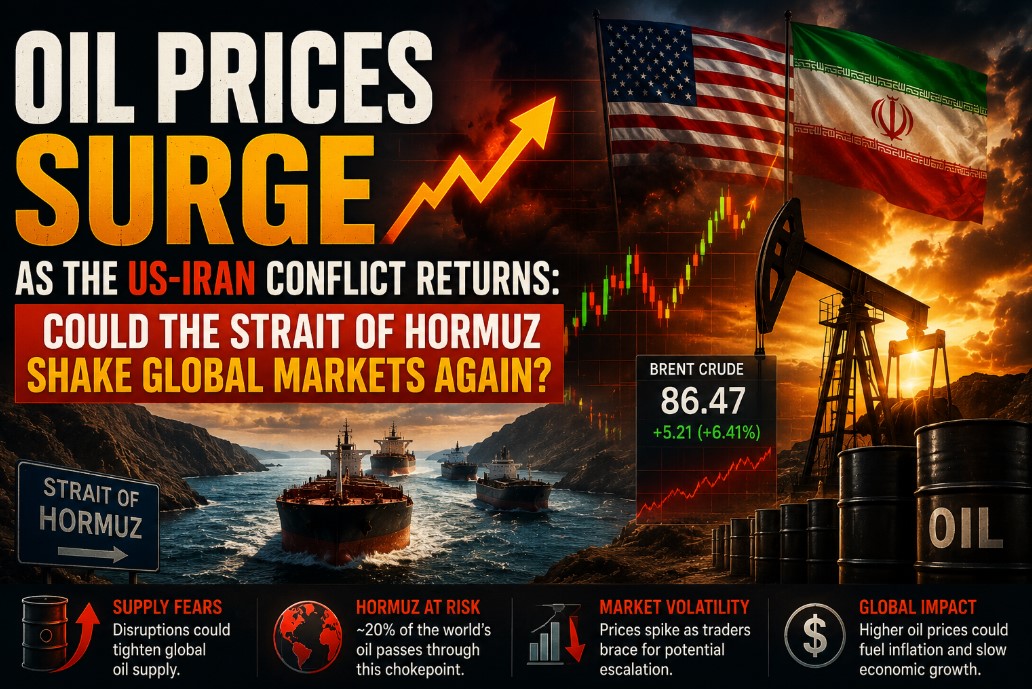
Oil Prices Surge as the US-Iran Conflict Returns: Could the Strait of Hormuz Shake Global Markets Again?
Last updated: July 13, 2026
Reviewed by the CryptoCasinoRad Editorial Team
Oil markets have returned to a familiar and uncomfortable position in July 2026. After several weeks in which traders had started to believe that the worst phase of the Middle East energy crisis might finally be easing, renewed fighting between the United States and Iran has pushed geopolitical risk straight back into the price of crude. Brent crude jumped more than 3% to around $78 per barrel, while West Texas Intermediate moved back above $73 as military strikes, attacks on commercial shipping and conflicting claims over the status of the Strait of Hormuz reminded markets that the world’s most important energy chokepoint remains anything but secure. The immediate price move was sharp, but what matters more than one volatile trading session is the reason behind it: the oil market still has very little confidence that shipping through the Gulf can return to normal without another disruption.
One of the easiest mistakes investors make during a geopolitical crisis is assuming that oil prices only rise after physical supplies disappear. In reality, financial markets rarely wait for confirmation. Traders begin pricing in risk as soon as they believe there is a realistic possibility that tankers could be delayed, insurance costs could rise or exporters could struggle to move crude through an important route. By the time an actual shortage becomes visible in official data, much of the first price move may already have happened. That is exactly what we are seeing now. Iran says it has restricted or closed parts of the Strait of Hormuz, while the United States insists commercial traffic is still moving and that an alternative southern route remains available. Both statements can contain part of the truth at the same time: a shipping lane does not need to be completely sealed for the oil market to treat it as dangerous. Slower vessel traffic, attacks on individual ships, mine warnings and uncertainty over which routes are considered safe can all reduce effective supply even when some tankers continue passing through.
Why the Strait of Hormuz Matters More Than Almost Any Other Shipping Route
The Strait of Hormuz is not simply another busy waterway. It is the narrow exit from the Persian Gulf through which oil and gas exports from several of the world’s largest producers reach international buyers. Before the current crisis, approximately 20 million barrels of oil and petroleum products passed through the strait each day, equal to roughly one-fifth of global petroleum liquids consumption and about one-quarter of all oil traded by sea. Saudi Arabia, Iraq, the United Arab Emirates, Kuwait, Qatar and Iran all depend on the route to varying degrees, while Asian economies including China, India, Japan and South Korea are among the largest buyers of the energy moving through it. There are pipelines that can bypass part of the strait, but their capacity is nowhere near large enough to replace normal seaborne traffic if shipping is severely disrupted.
That scale is what makes even rumours about Hormuz powerful enough to move global markets. Oil is not priced only according to how much crude is being produced underground; it is priced according to whether that crude can reach refineries on time, whether shipping companies are willing to carry it and whether buyers believe replacement barrels will be available. A producer can have millions of barrels ready for export, but if tankers cannot move safely through the Gulf, those barrels become far less useful to the global economy. This is also why the crisis has affected more than crude oil. Liquefied natural gas, refined fuels, petrochemicals and fertiliser products use many of the same shipping routes, meaning a prolonged disruption can spread into electricity prices, food production, manufacturing costs and inflation far beyond the Middle East.
The International Energy Agency has described the 2026 Hormuz disruption as the largest oil-supply shock in history. According to the agency, flows through the strait fell from around 20 million barrels per day before the conflict to an average of approximately 2.7 million barrels per day during March, April and May, while cumulative supply losses from Middle Eastern producers exceeded 1.3 billion barrels. Those figures explain why the market remains so sensitive today. Even though traffic and output had started recovering, inventories have already been drained, supply chains have already been reorganised and buyers remain nervous about relying on routes that could become dangerous again with almost no warning.
Why Oil Can Rise on War Headlines and Fall the Next Day
The most confusing part of the current market is that oil prices can rise sharply on military escalation and then fall just as quickly even though the conflict has not ended. That does not necessarily mean traders have stopped caring about the war. It means oil is being pulled between two powerful forces: supply fear and demand fear.
On one side, attacks near the Strait of Hormuz increase the possibility that fewer barrels will reach the market. That is bullish for prices. On the other side, expensive energy can weaken the global economy, reduce consumer spending, increase business costs and eventually lower demand for fuel. That is bearish for prices. We saw this tension clearly in July when Brent and WTI fell around 2% during one session because concerns about inflation and slower economic growth outweighed continuing supply restrictions. Brent settled near $76.30 and WTI near $72.08 even though the Strait of Hormuz had not fully returned to normal.
This is an important point because headlines often make oil sound much simpler than it really is. “War begins, oil rises” is easy to understand, but it is not a complete model. If prices rise too far, governments release emergency reserves, producers outside the region increase output, consumers use less fuel, airlines reduce capacity and industries delay energy-intensive activity. At the same time, high prices can accelerate inflation and force central banks to keep interest rates elevated, which can slow economic growth further. Eventually, the market begins asking whether the demand destruction caused by expensive oil might become larger than the supply loss that originally pushed prices higher. That is one reason crude can fall during an active conflict without the underlying geopolitical danger disappearing.
What Has Changed Since the Earlier 2026 Oil Shock?
The current situation is not starting from zero. Earlier in 2026, the near-closure of Hormuz created an enormous supply disruption and sent some physical crude benchmarks toward levels around $130 per barrel. Refiners struggled to replace missing Middle Eastern cargoes, governments released emergency stocks and producers outside the Gulf were encouraged to increase supply as quickly as possible. Since then, the market has adapted. Trade routes have been rearranged, some exports have been redirected through pipelines, production outside the region has increased and consumers have become more cautious. These adjustments have reduced the immediate risk of the kind of uncontrolled price spike seen earlier in the year.
But adaptation should not be confused with full recovery. The International Energy Agency’s outlook depends heavily on a gradual restoration of tanker traffic through Hormuz. If vessels continue returning and Gulf producers are able to restore output, global supply could recover strongly and potentially move toward a surplus in 2027. If fighting intensifies again, that recovery scenario becomes much weaker. This is why prices around $70–$80 should not automatically be interpreted as proof that the crisis is over. The market is effectively giving some probability to diplomacy succeeding and some probability to another serious disruption. Every military strike, shipping incident or negotiation changes that balance.
Our view is that the market has become less shocked by individual headlines but remains highly vulnerable to evidence of sustained shipping disruption. A missile strike that causes limited damage may create a short-lived price jump. A week of collapsing tanker traffic would be much more serious. Traders are no longer reacting only to the language used by Washington or Tehran; they are watching actual vessel movements, insurance premiums, export volumes and whether commercial operators believe the route is safe enough to use. That is a healthier way to judge the situation because political claims are often designed for domestic audiences, while shipping data shows what companies are actually willing to risk.
Could Oil Return to $100?
A move back toward $100 is possible, but it would probably require more than another round of aggressive statements. The strongest bullish scenario would involve a prolonged reduction in Hormuz traffic, repeated attacks on tankers, damage to major export terminals or evidence that Gulf producers cannot restore output quickly. Under those conditions, buyers would begin competing more aggressively for replacement barrels from the United States, Brazil, Guyana, Norway, Canada and West Africa. Freight costs would rise, refinery margins could become more volatile and governments might be forced to release more strategic reserves. Given how much oil normally moves through Hormuz, even a partial disruption sustained over several weeks could create a meaningful risk premium.
However, oil reaching $100 and remaining there are two different questions. A temporary spike is easier to imagine than a stable new price level. The higher crude moves, the stronger the economic response becomes. Consumers reduce driving, airlines hedge or cut routes, industrial demand softens and political pressure grows for producers to increase output. The United States also has significant domestic production, while OPEC+ countries outside the immediate disruption may have incentives to raise supply. A sustained move above $100 would therefore require the physical shortage to remain larger than the global market’s ability to adapt.
There is also a bearish scenario that deserves equal attention. If the United States and Iran return to negotiations, if all major shipping lanes reopen and if tanker traffic normalises faster than expected, the geopolitical premium could disappear quickly. The IEA has already warned that a successful Hormuz recovery could eventually contribute to a significant global supply surplus in 2027. In that environment, Brent could fall back toward the $60s or possibly lower, especially if economic growth remains weak.
That is why traders placing heavily leveraged bets on only one outcome face substantial risk. A person can be correct that the geopolitical situation is dangerous and still lose money if the market has already priced in more danger than eventually occurs. They can also be correct that global supply is recovering and still be liquidated by a sudden military escalation. Oil futures are not simply a referendum on whether war is good or bad for supply; they are a constantly changing calculation of probabilities, timing and expectations.
What Rising Oil Means for Inflation and Ordinary Consumers
Oil prices do not remain inside financial markets. They eventually reach households and businesses through petrol, diesel, aviation fuel, heating costs, shipping rates and the prices of goods transported around the world. If crude stays elevated, fuel costs usually begin rising with a delay, although taxes, refinery margins and currency movements influence how much consumers actually pay. Countries that import most of their energy are particularly exposed because they must purchase oil in international markets, often using US dollars.
The wider inflation impact can become even more important than the direct cost at the petrol station. Higher diesel prices increase the cost of moving food and goods. More expensive jet fuel affects airfares. Petrochemicals are used in plastics, packaging, fertilisers and countless industrial products. Businesses facing higher energy bills may pass part of those expenses to customers, while governments may respond with subsidies or tax reductions that increase budget pressure. If the shock lasts long enough, central banks can find it more difficult to cut interest rates because headline inflation begins rising again.
This creates an uncomfortable cycle. Higher oil supports energy producers but harms many energy-consuming industries. It can benefit shares of major oil companies while pressuring airlines, transport businesses, manufacturers and consumer-focused companies. It can also weaken emerging-market currencies, particularly in countries that import large quantities of fuel. For investors, the result is rarely as simple as “oil up, energy stocks up.” The broader economic consequences can eventually pull the entire market lower if inflation and recession fears become strong enough.
How Could the Crisis Affect Bitcoin and the Crypto Market?
The relationship between oil and crypto is indirect but increasingly important. Bitcoin does not consume oil in the same way an airline or shipping company does, yet the market reacts to the economic consequences of an energy shock. If oil prices rise sharply, inflation expectations can increase. That may encourage central banks to delay interest-rate cuts or maintain tighter monetary policy, which is usually difficult for speculative assets. Crypto markets often perform best when liquidity is improving, interest rates are falling and investors are comfortable taking risk. A prolonged oil shock can produce the opposite environment.
During the first phase of geopolitical escalation, Bitcoin may also trade like a risk asset rather than a safe haven. Investors often reduce leverage, sell volatile positions and move into cash, short-term government debt or traditional safe-haven assets. Later, the narrative can change. If governments respond with large spending programmes, monetary support or currency debasement, some investors may once again view Bitcoin as protection against inflation and political instability. The timing is unpredictable, which is why crypto can initially fall on war headlines and then recover while the conflict is still ongoing.
For CryptoCasinoRad readers, this matters because many players hold Bitcoin, Ethereum, Litecoin or USDT before depositing at online casinos. When crypto prices are extremely volatile, using stablecoins can make bankroll management easier because the value of the deposit does not change dramatically before or after a playing session. Bitcoin and altcoin users should also remember that a profitable withdrawal measured in coins can still lose value in fiat terms if the wider market falls sharply.
Explore our related guides:
Best Crypto Casinos 2027
https://cryptocasinorad.com/best-crypto-casinos-2027/
Best USDT Casinos
https://cryptocasinorad.com/best-usdt-casinos/
Instant Withdrawal Casinos
https://cryptocasinorad.com/instant-withdrawal-casinos/
Latest Crypto Market News
https://cryptocasinorad.com/news/
Three Oil-Market Scenarios for the Coming Months
1. De-escalation and Gradual Reopening
The most positive scenario would involve renewed negotiations, clearer guarantees for commercial shipping and a steady return of tanker traffic. Under this outcome, the geopolitical premium could decline, Gulf production could recover and global supply might rebuild faster than demand. Brent could gradually move lower, especially if economic growth remains weak. Energy consumers would benefit, inflation pressure would ease and central banks would have more flexibility to lower interest rates.
2. An Unstable Middle Ground
This may be the most realistic near-term scenario. Shipping continues, but traffic remains below normal. Occasional attacks or warnings create sharp price moves, while diplomacy prevents the conflict from becoming a full regional war. Brent and WTI could remain volatile within a broad range, rising on military headlines and falling when talks appear productive. This environment would be difficult for leveraged traders because both bullish and bearish positions could be punished repeatedly.
3. Major Escalation and Renewed Supply Shock
The most dangerous scenario would involve sustained attacks on commercial vessels, mining of shipping lanes, damage to export infrastructure or direct involvement from additional regional powers. Tanker traffic could fall sharply, insurance costs could become prohibitive and replacement barrels might not arrive quickly enough. Oil could move back toward $100 or above, while inflation, equity markets and global economic growth would come under significant pressure.
The key point is that none of these outcomes should be treated as guaranteed. The oil market is not pricing a single future. It is constantly adjusting the probability assigned to each scenario, which is why prices can move violently even when no physical barrel has changed hands.
What We Are Watching Now
The first indicator is actual tanker traffic through the Strait of Hormuz. Political statements matter, but shipping activity matters more. Reports that only a handful of vessels passed through the strait during the latest escalation show how quickly commercial caution can become a supply problem even without a universally recognised legal closure.
The second indicator is diplomacy. Qatar, Oman, Egypt and Pakistan have all been involved in attempts to reduce tensions, while the United States has demanded a clear guarantee that shipping lanes will remain open and vessels will not be attacked. A credible agreement would remove part of the price premium, but negotiations can collapse quickly if another ship is hit or military targets are attacked.
The third indicator is global demand. If oil remains expensive while economic growth weakens, traders may begin focusing less on shortages and more on declining consumption. That shift can cause prices to fall even before supply fully recovers.
Finally, we are watching emergency inventories and production outside the Gulf. Strategic stock releases and higher output from other regions helped stabilise the earlier shock. If those buffers are already depleted or slower to respond this time, the market may react more aggressively to another prolonged disruption.
Our Verdict
The renewed rise in oil prices is not simply another emotional reaction to dramatic headlines. It reflects a real and unresolved vulnerability in the global energy system. Around one-fifth of the world’s petroleum supply normally moves through a narrow waterway located beside one of the most dangerous military confrontations of 2026. No serious trader can ignore that risk.
At the same time, investors should be careful not to confuse risk with certainty. The Strait of Hormuz is not operating normally, but it is also not necessarily sealed in the absolute sense suggested by some headlines. Commercial traffic has slowed, alternative routes are limited and attacks have increased the danger, yet some vessels continue moving through the region. The difference matters because oil at $78 reflects a market that is worried, not a market that believes all Gulf exports have disappeared.
Our view is that volatility will remain unusually high until there is either a credible shipping agreement or clear evidence of another sustained collapse in traffic. Oil could move toward $90 or $100 if physical disruption worsens, but it could also fall quickly if diplomacy succeeds and production recovers. The most likely path may be neither a straight rally nor a clean collapse, but a nervous market repeatedly moving between war risk and economic weakness.
That may not produce the simple prediction many readers want, but it is the more honest conclusion. In geopolitical markets, the direction is often less important than understanding what could change it.