Crypto Casino Transaction Fees Explained (2027 Guide)
Last Updated: July 2026
One of the biggest reasons players switch from traditional banking to cryptocurrency is the promise of lower transaction costs. Spend a few minutes browsing casino forums and you’ll quickly find claims that crypto transfers are “free” or “cost next to nothing.”
Like many things in crypto, the reality is a little more nuanced.
After reviewing dozens of crypto casinos and comparing how different payment systems work, we’ve found that transaction fees depend on far more than the cryptocurrency you choose. The blockchain network, your wallet, current network activity and even the casino itself can all influence the final cost of moving your money.
The good news is that once you understand where these fees come from, they’re surprisingly easy to manage.
In this guide, we’ll explain what crypto transaction fees actually are, why they exist and how experienced players minimise them without sacrificing convenience.
How We Researched This Guide
Rather than relying on promotional claims from casinos or wallet providers, we compared payment systems used across the crypto casinos featured on CryptoCasinoRad.
We focused on questions real players ask before making a deposit:
- Which cryptocurrencies usually have the lowest fees?
- Does the casino charge anything on top of blockchain fees?
- How much do different blockchain networks vary?
- Are expensive networks actually worth paying for?
- Which options make the most sense for everyday gambling?
Our goal isn’t to recommend the cheapest network in every situation. It’s to help players understand when paying a little more actually delivers a better overall experience.
The Biggest Myth About Crypto Fees
Let’s start with one misconception we encounter surprisingly often.
Many new players believe the casino decides how much a crypto transaction costs.
In most cases, that’s simply not true.
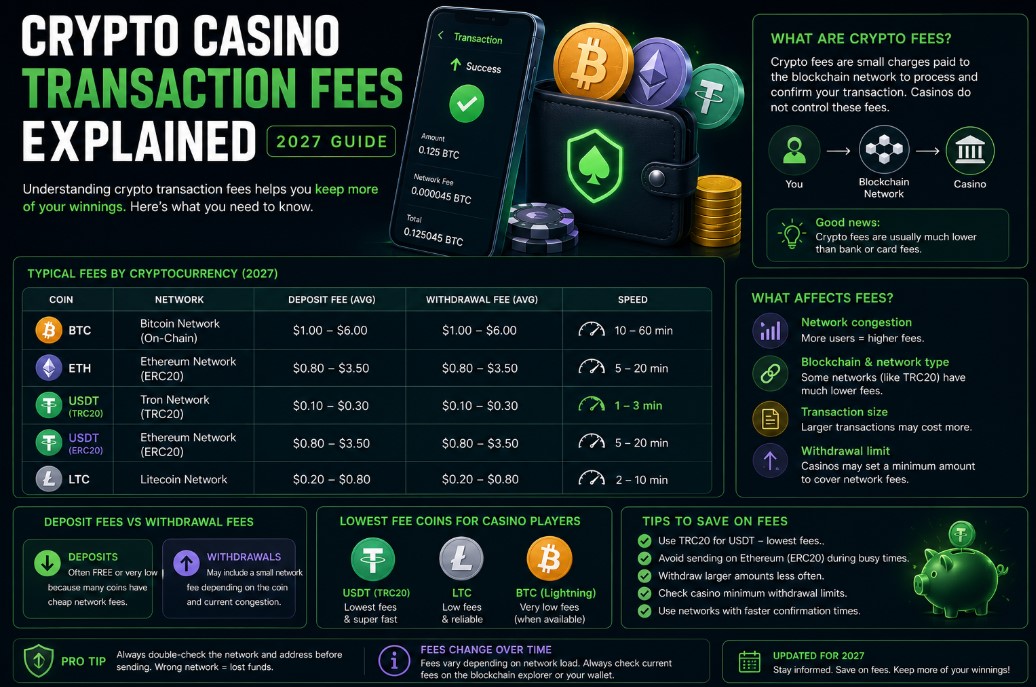
The majority of the fee you’re paying isn’t collected by the casino at all. It’s paid to the blockchain network responsible for processing and validating your transaction.
Think of it as paying for the infrastructure that moves your cryptocurrency from one wallet to another.
The casino usually receives the funds—but the network performs the work.
Our Take
One thing that stood out during our research is how often casinos are blamed for fees they don’t actually control.
In reality, many casinos don’t charge deposit fees at all. What players are seeing is simply the blockchain network fee generated by their own wallet when the transaction is broadcast.
Understanding that distinction makes comparing payment methods much easier.
Who Actually Receives The Fee?
The answer depends on the type of fee you’re looking at.
| Fee Type | Who Receives It? | Can You Avoid It? |
|---|---|---|
| Blockchain Network Fee | Blockchain validators or miners | Usually not |
| Casino Processing Fee | Casino | Depends on the operator |
| Exchange Withdrawal Fee | Crypto exchange | Sometimes |
| Currency Conversion Fee | Exchange or payment provider | Yes, by avoiding conversions |
One thing we’ve learned is that many players only notice the first fee while completely overlooking the others.
If you’re withdrawing from an exchange before depositing into a casino, your total cost may include both the exchange withdrawal fee and the blockchain fee.
Why Bitcoin Fees Sometimes Surprise New Players
Bitcoin remains the most recognised cryptocurrency in online gambling, but it’s not always the cheapest option.
This surprises many beginners because Bitcoin is often treated as the default payment method.
The explanation is relatively simple.
Bitcoin’s blockchain is incredibly secure and widely trusted, but when network activity increases, transaction fees can rise as users compete to have their transactions confirmed sooner.
That doesn’t make Bitcoin a poor choice.
Far from it.
It simply means there are situations where another cryptocurrency may be more practical for smaller deposits.
If you’re comparing payment methods, it’s worth reading our guides to Best Bitcoin Casinos and Best Litecoin Casinos to see how different networks fit different playing styles.
Small Deposit? The Fee Matters More Than You Think
Here’s a simple example that illustrates why network fees deserve attention.
Imagine you’re depositing the equivalent of $50.
A network fee of just a few dollars may not seem significant in absolute terms, but as a percentage of your bankroll, it suddenly becomes much more noticeable.
Now imagine making that same deposit using a blockchain with substantially lower fees.
Nothing changes about the casino.
Nothing changes about the games.
The only difference is that more of your money actually reaches your playing balance.
That’s one reason many regular players gradually move toward networks like TRON or Litecoin for everyday gambling, while continuing to use Bitcoin for larger transfers.
Comparing The Most Popular Crypto Networks
If you spend enough time reading crypto casino forums, you’ll eventually notice players arguing about which cryptocurrency is “best.”
In our experience, that’s the wrong question.
A better question is:
“Which network makes the most sense for this particular transaction?”
After comparing payment systems across dozens of casinos, we found that each blockchain has its own strengths. None of them wins every category.
| Network | Typical Cost | Speed | Our Take |
|---|---|---|---|
| Bitcoin | Variable | Good | Excellent for larger transfers and maximum compatibility. |
| Litecoin | Low | Fast | One of the most practical everyday options. |
| TRON (TRC20) | Very Low | Very Fast | Outstanding for regular USDT transfers. |
| Ethereum | Can Be Higher | Good | Ideal if you’re already using the Ethereum ecosystem. |
| Solana | Low | Very Fast | One of the most promising payment networks. |
Our Experience: Players Often Optimise The Wrong Thing
One thing surprised us while researching this guide.
Many players spend hours comparing tiny differences in network fees while completely ignoring something much more important:
the casino itself.
Saving fifty cents on a blockchain fee won’t matter very much if the casino takes two days to approve your withdrawal.
Likewise, paying a slightly higher network fee may be perfectly reasonable if it allows you to use a wallet you’re already familiar with.
This is why we rarely recommend choosing a cryptocurrency based solely on transaction costs.
Instead, we suggest looking at the entire payment experience:
- Does the casino support your preferred network?
- Are withdrawals processed consistently?
- Does your wallet support that blockchain?
- Will you need to convert currencies later?
Sometimes the cheapest option is also the most convenient.
Sometimes it isn’t.
When Paying A Higher Fee Actually Makes Sense
There’s a tendency among new crypto users to assume that lower fees automatically mean a better transaction.
That’s not always true.
Imagine you’re withdrawing the equivalent of $5,000.
At that point, the difference between paying a network fee of fifty cents or five dollars becomes relatively insignificant.
Reliability suddenly matters much more than squeezing every last cent out of the transaction.
On the other hand, if you’re depositing $40 to try a few slot games after work, paying several dollars in fees feels much less attractive.
Context changes everything.
Editorial Observation
We often see articles recommending the same cryptocurrency for every player.
Our experience has been different.
Someone making occasional $1,000 deposits has completely different priorities from someone depositing $25 every Friday evening.
That’s why we prefer matching the payment method to the player instead of trying to crown a single “best” cryptocurrency.
Do Casinos Add Their Own Fees?
This is another question that appears regularly in our inbox.
The answer is:
Sometimes—but less often than many players expect.
Many crypto-first casinos advertise fee-free deposits because they don’t add their own processing charge.
That doesn’t necessarily mean the transaction costs nothing.
You’ll still pay the blockchain network fee generated by your wallet.
Some casinos may also apply fees in specific situations, such as very small withdrawals, currency conversions or exceptional payment methods.
That’s why we always recommend checking the cashier and payment policy rather than relying solely on promotional banners.
Our Checklist Before Every Deposit
Before sending cryptocurrency to any casino, we go through the same short checklist.
- ✓ Confirm the cryptocurrency.
- ✓ Confirm the blockchain network.
- ✓ Check the wallet address.
- ✓ Review any minimum deposit requirements.
- ✓ Estimate the current network fee.
- ✓ Verify the casino supports the chosen network.
It sounds almost too simple.
Yet those six checks eliminate the overwhelming majority of payment problems we’ve encountered while researching crypto casinos.
Small Changes Can Save More Than You Think
When people hear the phrase “transaction fees,” they usually think about a few cents or a couple of dollars. It doesn’t sound particularly important.
But after comparing how regular crypto casino players manage their bankrolls, we noticed something interesting.
The biggest savings rarely come from finding the cheapest possible blockchain.
They come from avoiding unnecessary transactions altogether.
For example, moving funds from an exchange to Wallet A, then to Wallet B, and finally to a casino means paying network fees multiple times. In many cases, a player could have deposited directly from their preferred wallet and avoided an extra transaction entirely.
It’s a small detail, but over months of regular play those unnecessary fees begin to add up.
Planning Your Deposits Makes A Difference
One habit we’ve gradually adopted while testing crypto casinos is avoiding unnecessary micro-deposits.
It’s tempting to send $20 today, another $30 tomorrow and perhaps another $15 later in the week.
The problem isn’t the casino.
It’s that every blockchain transaction has its own cost.
Making one larger deposit instead of several smaller ones can often reduce your overall transaction costs without changing your gambling budget at all.
Obviously, bankroll management always comes first. Never deposit more than you’re comfortable playing with. But if you’ve already decided how much you’re willing to spend, reducing the number of transfers can be a surprisingly effective way to minimise fees.
How Different Casinos Handle Payments
Another thing that became obvious during our reviews is that not every casino presents payment information equally well.
The best operators make the process almost impossible to misunderstand.
You’ll usually find clear network labels, estimated confirmation times, minimum deposit amounts and helpful reminders before you confirm the transaction.
Others provide very little guidance. The cashier may simply display a wallet address and expect players to know exactly what they’re doing.
This is one reason we pay close attention to the overall payment experience when reviewing casinos—not just whether they accept Bitcoin or USDT.
Good payment design reduces mistakes. Poor payment design creates unnecessary support tickets.
Who Should Pay Close Attention To Transaction Fees?
Occasional Players
If you only deposit occasionally, transaction fees probably won’t have a significant impact on your overall gambling budget. Convenience and compatibility are usually more important than saving a small amount on each transfer.
Regular Players
If you’re depositing or withdrawing several times each month, choosing an efficient blockchain network can noticeably reduce your long-term costs.
High Rollers
For larger transactions, consistency, withdrawal reliability and casino reputation often matter far more than tiny differences in blockchain fees.
Related Reading
If you’re still deciding which payment method suits your style of play, these guides are the best place to continue your research:
- How To Deposit Crypto At Online Casinos
- How To Withdraw Crypto From Online Casinos
- TRC20 vs ERC20 vs BEP20 For Casino Players
- Best Crypto Networks For Gambling
- Best Crypto Wallets For Online Gambling
- Best Bitcoin Casinos 2027
- Best USDT Casinos 2027
Who Is This Guide For?
This guide is designed for players who want to understand where crypto transaction fees actually come from instead of relying on oversimplified advice.
It’s particularly useful if you’re:
- Making your first cryptocurrency deposit.
- Comparing Bitcoin, Litecoin, Ethereum and TRON.
- Trying to reduce unnecessary payment costs.
- Choosing between different blockchain networks.
- Looking for a casino with transparent payment policies.
Pros & Cons Of Crypto Payments
What We Like
- Greater control over your funds.
- Access to multiple cryptocurrencies.
- Often lower costs than some traditional international payment methods.
- Transparent transactions recorded on the blockchain.
- Excellent compatibility with modern crypto casinos.
Things To Keep In Mind
- Network fees change depending on blockchain activity.
- Using the wrong blockchain network can cause serious problems.
- Some exchanges charge additional withdrawal fees.
- Not every casino supports every blockchain.
- Learning the basics takes a little time.
Our Verdict
After researching crypto payment systems across dozens of online casinos, one conclusion kept coming up.
Transaction fees matter—but probably not in the way most new players expect.
The goal isn’t to hunt for the absolute cheapest blockchain every time you gamble.
It’s to understand why you’re paying a fee, what you’re getting in return and whether the payment method fits the way you actually play.
For everyday deposits, lower-cost networks such as TRON and Litecoin often make excellent practical choices. For larger transfers, many players are happy to pay a little more for the familiarity and widespread support of Bitcoin or Ethereum.
Our advice is simple: don’t optimise for one number on a fee screen. Look at the complete payment experience, choose reputable casinos with transparent banking policies and use a blockchain that matches both your wallet and your playing habits.
That’s the approach we’ve gradually adopted while reviewing crypto casinos, and it’s the one we’d recommend to anyone getting started with crypto gambling in 2027.