
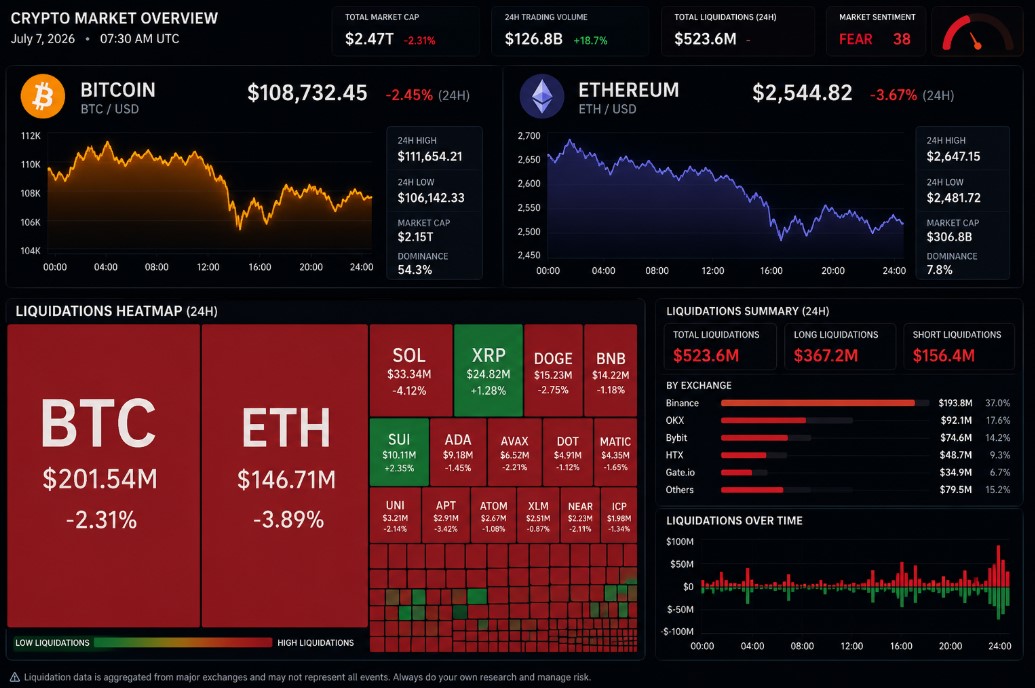
Crypto Market Outlook – July 2026: Billions in Liquidations, Nervous Investors and a Market Looking for Direction
Last updated: July 2026
Reviewed by the CryptoCasinoRad Editorial Team
Just a few weeks ago, it felt like the crypto market had finally found its footing again. Bitcoin had started climbing away from its late-June lows, Ethereum was showing signs of renewed strength, and social media was once again filling up with predictions that the next leg of the bull market was only days away. As always in crypto, optimism returned surprisingly quickly. It only takes a few strong green candles for sentiment to swing from panic to euphoria, and anyone who has followed this market for more than a single cycle knows how familiar that pattern has become.
Today, however, the mood is much more complicated.
Prices have recovered from the sharp sell-off seen at the end of June, but confidence hasn’t recovered at the same pace. Bitcoin has bounced back into the low-to-mid $60,000 range after dipping below $58,000, helped by renewed ETF inflows and an aggressive short squeeze, yet traders remain cautious rather than euphoric. Ethereum has also regained some ground, while Solana and several other major altcoins have posted respectable rebounds. On paper, that sounds encouraging. In reality, the market still feels like it’s waiting for confirmation before committing to the next major move.
That’s probably the most interesting thing about July so far.
The prices and the psychology no longer tell the same story.
One of the clearest examples is the Fear & Greed Index. Despite Bitcoin recovering more than 6% over the past week, overall market sentiment has remained stuck in Extreme Fear territory. Normally, a recovery of this size would bring back optimism almost immediately. This time, investors appear far more reluctant to believe the rally. After months of sharp reversals, failed breakouts and disappointing ETF flow data, many traders seem determined to see stronger evidence before declaring that the worst is over.
What Really Moved the Market This Week?
Looking beyond the daily candles, one word keeps appearing in almost every market report: liquidations.
Crypto remains one of the most heavily leveraged financial markets in the world. Unlike traditional investing, where many participants simply buy and hold assets, a significant portion of crypto trading happens through perpetual futures and leveraged positions. That creates enormous opportunities—but it also means that when prices move quickly, thousands of positions can disappear within minutes.
Over the last few days, that’s exactly what happened.
As Bitcoin pushed higher, bearish traders who had been betting on further declines found themselves trapped. Short positions worth hundreds of millions of dollars were liquidated in a remarkably short period, forcing exchanges to automatically buy back Bitcoin to close those positions. That buying pressure then pushed prices even higher, triggering even more liquidations in a classic short squeeze. Estimates suggest that roughly $500 million in crypto positions were wiped out in just twenty-four hours, with short sellers accounting for the majority of those losses.
If you’ve ever wondered why crypto prices sometimes seem to explode upward without an obvious piece of news, this is often the answer.
Not every rally begins because investors suddenly become optimistic.
Sometimes prices rise simply because too many traders were positioned the wrong way.
That’s one of the reasons crypto remains such an emotional market. Technical factors can temporarily matter just as much as fundamental developments.
ETF Flows Continue to Dictate the Conversation
Over the past eighteen months, one theme has consistently influenced Bitcoin more than almost anything else: ETF flows.
When money enters spot Bitcoin ETFs, confidence usually improves. When those funds experience sustained outflows, the market tends to become much more defensive.
July has once again demonstrated that relationship.
After suffering several sessions of net outflows, Bitcoin ETFs finally recorded fresh inflows exceeding $200 million, helping stabilize sentiment and supporting the latest recovery. At the same time, it’s worth remembering that the broader picture remains mixed. Although recent inflows are encouraging, they only partially offset the significant capital that left these products during previous weeks. Several analysts continue describing the rebound as fragile until ETF demand becomes consistently positive again.
From our perspective, this is one of the biggest themes to watch through the rest of the summer.
Retail investors still generate headlines.
Institutional money still moves markets.
Why the Market Still Feels Nervous
One thing we’ve learned after following crypto through multiple bull and bear markets is that price alone rarely tells the full story.
What matters just as much is confidence.
Right now, confidence feels… hesitant.
Developers continue building.
Stablecoin usage continues expanding.
Major exchanges continue launching products.
Institutional investors haven’t disappeared.
Yet traders remain reluctant to embrace risk in the same way they did during previous rallies.
Part of that hesitation comes from macroeconomics. Interest-rate expectations continue changing, inflation remains a concern in several major economies, and geopolitical developments have repeatedly reminded investors that crypto doesn’t exist in isolation. Even assets built around decentralisation still react to global risk sentiment. Recent geopolitical headlines briefly pushed Bitcoin and major altcoins lower before buyers stepped back in, highlighting just how sensitive digital assets remain to events outside the blockchain ecosystem.
That’s why we think describing the current environment as either “bullish” or “bearish” misses the point.
The market feels transitional.
And transitional markets are often the hardest to trade.
Could the Bull Market Continue?
This is the question everyone wants answered.
Unfortunately, anyone claiming certainty probably isn’t being honest.
There are certainly reasons for optimism.
Bitcoin has defended several important support areas.
Institutional participation remains far stronger than it was during previous crypto winters.
The infrastructure surrounding digital assets continues improving, and regulatory clarity is gradually increasing in several jurisdictions.
On the other hand, there are equally valid reasons for caution.
ETF demand remains inconsistent.
Open interest has fallen, suggesting that conviction behind the latest rally may not be as strong as price action alone suggests.
Large investors continue watching macroeconomic data just as closely as blockchain metrics.
Our view is fairly straightforward.
We don’t think this looks like the beginning of another prolonged crypto winter.
But neither does it resemble the explosive optimism that typically defines the strongest phases of a bull market.
Instead, it feels like a market searching for its next major narrative.
Whether that narrative becomes renewed institutional buying, lower interest rates, stronger ETF demand or something entirely unexpected remains to be seen.
What We’re Watching Over the Next Few Weeks
Rather than focusing on every hourly price movement, there are a handful of indicators we believe deserve far more attention than social media hype.
First, ETF flows. If institutional demand continues recovering, that would strengthen the case for a more sustainable rally.
Second, liquidation data. Large liquidation events often reveal where traders have become excessively confident, and crypto has a habit of punishing consensus.
Third, macroeconomic news. Central-bank decisions and inflation data continue influencing risk assets across the board, and crypto is unlikely to ignore them.
Finally, market psychology itself.
One of the most fascinating aspects of July has been watching prices recover faster than investor confidence. Historically, those periods have often produced either surprisingly strong breakouts—or disappointing reversals. The next few weeks should help determine which path this market ultimately chooses.
What This Means for Crypto Casino Players
Interestingly, uncertainty in crypto markets doesn’t necessarily translate into lower activity at crypto casinos. In previous market cycles we’ve often noticed that some players reduce speculative trading while continuing to use cryptocurrencies for entertainment, particularly at casinos offering instant withdrawals, stablecoin support and flexible payment options.
If you’re looking for trusted crypto-friendly operators while the market remains volatile, explore:
Best Crypto Casinos
https://cryptocasinorad.com/best-crypto-casinos-2027/
Instant Withdrawal Crypto Casinos
https://cryptocasinorad.com/instant-withdrawal-casinos/
No KYC Crypto Casinos
https://cryptocasinorad.com/no-kyc-crypto-casinos/
Our Verdict
If we had to summarise the crypto market in one sentence, it would be this:
Prices are recovering faster than confidence.
That doesn’t automatically mean another major rally is around the corner, nor does it suggest the bull market has ended. It simply means investors are becoming more selective, more patient and, perhaps for the first time in a while, more realistic.
Crypto has always been a market driven by emotion, but beneath the daily volatility there are still encouraging signs. Infrastructure continues improving. Institutional participation remains meaningful. Innovation hasn’t stopped.
For now, we’re staying cautiously optimistic.
Not because every chart suddenly looks bullish, but because the long-term foundations appear considerably stronger than they did during previous market downturns.
The next few months are likely to be defined less by hype and more by evidence—and that’s probably a healthy direction for the industry.