How To Deposit Crypto At Online Casinos (2027 Guide)
If you’ve never deposited cryptocurrency into an online casino before, the process can feel more intimidating than it actually is. Unlike using a debit card or an e-wallet, crypto payments introduce a few extra concepts—wallet addresses, blockchain networks, confirmations and transaction fees. None of them are particularly difficult to understand, but getting one small detail wrong can be expensive.
After reviewing dozens of crypto-friendly casinos over the past year, one thing became clear to us. Most payment problems don’t happen because casinos are unreliable. They happen because players rush through the deposit process without checking which network they’re using or whether their wallet actually supports the transaction they’re about to send.
We’ve seen players send USDT using the wrong blockchain, copy outdated wallet addresses or assume every casino supports every cryptocurrency in exactly the same way. In reality, each operator has slightly different payment rules, and understanding those differences is one of the easiest ways to avoid unnecessary frustration.
This guide explains how crypto casino deposits work from start to finish. We’ll walk through the process step by step, highlight the mistakes we see most often and share the same checklist our editorial team uses when evaluating casino payment systems.
How We Evaluate Crypto Casino Payment Systems
At CryptoCasinoRad, we don’t recommend casinos simply because they accept Bitcoin or advertise “instant crypto deposits.” Every payment system is reviewed as part of our wider casino evaluation process.
When testing a casino, we look beyond the marketing claims and focus on the practical experience players actually have. Our reviews consider factors such as supported cryptocurrencies, available blockchain networks, deposit minimums, confirmation requirements, cashier usability and payment transparency.
We also compare how casinos explain their payment process. Some provide clear instructions with network warnings and estimated processing times, while others leave players to figure everything out themselves. That difference may seem small until you’re transferring real money.
What We Check
- Supported cryptocurrencies
- Available blockchain networks
- Minimum deposit requirements
- Confirmation times
- Deposit fees (if any)
- Ease of use inside the cashier
- Transparency of payment information
The Short Version
If you already own cryptocurrency, making your first casino deposit usually takes less than five minutes.
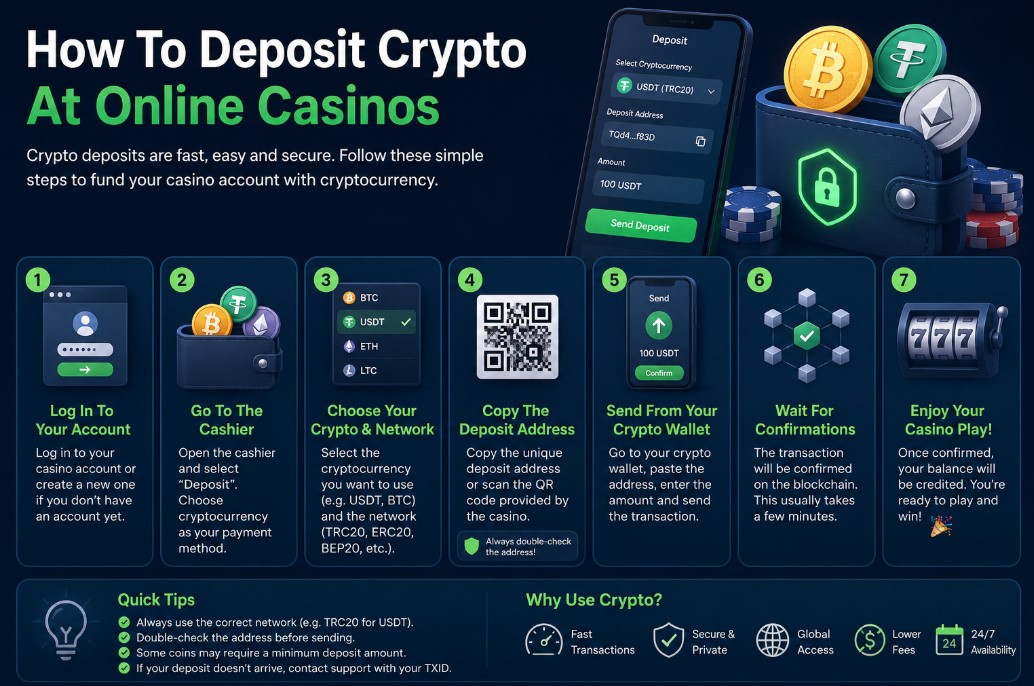
The process itself is straightforward:
- Create or log into your casino account.
- Open the Cashier or Banking section.
- Select Cryptocurrency as your payment method.
- Choose the cryptocurrency you want to deposit.
- Copy the wallet address provided by the casino.
- Send the funds from your crypto wallet.
- Wait for the required blockchain confirmations.
- Your casino balance updates automatically.
Simple on paper.
The details behind those eight steps are what separate a smooth experience from an expensive mistake.
Why Crypto Deposits Work Differently
One thing that stood out to us after comparing crypto casinos with traditional online casinos is how different the payment process actually is.
Traditional deposits rely on banks, payment processors or card networks. Crypto deposits don’t.
Instead, your transaction moves directly across a blockchain from one wallet to another. The casino doesn’t “pull” money from your account the way a debit card payment works. You initiate the transaction yourself, approve it inside your wallet and the blockchain verifies everything independently.
That has several advantages. Deposits aren’t limited by banking hours, international transfers are usually much simpler and players often have access to a wider range of currencies than traditional casinos support.
However, blockchain transactions also come with one important difference:
They generally can’t be reversed.
If you accidentally send funds to the wrong wallet address or use an unsupported blockchain network, there usually isn’t a customer support agent who can simply cancel the payment.
That’s why experienced crypto players spend a few extra seconds checking every detail before clicking “Send.”
Before You Deposit Anything
Before reviewing any casino, we always go through the same payment checklist ourselves. It takes less than two minutes and often reveals potential problems before real money is involved.
| Question | Why It Matters |
|---|---|
| Which cryptocurrencies are supported? | Not every casino accepts every coin. |
| Which blockchain networks are available? | USDT, for example, exists on multiple networks. |
| Is there a minimum deposit? | Very small transfers may not qualify. |
| How many confirmations are required? | This affects how quickly funds appear. |
| Are there any fees? | Some casinos cover network costs, others don’t. |
It’s surprising how often players skip these basic checks. Most payment issues we encounter during research could have been avoided by reviewing this information before making the deposit.
Choosing The Right Cryptocurrency
One question comes up surprisingly often when readers contact us:
“Which cryptocurrency should I actually use?”
There isn’t a universal answer because the best choice depends on how you plan to play.
After comparing payment systems across dozens of crypto casinos, we’ve noticed that different cryptocurrencies tend to appeal to different types of players.
Bitcoin remains the most recognised option. If you’re opening a casino cashier for the first time, BTC will almost always be available. It has become the industry’s default currency and is supported by virtually every major crypto gambling platform.
The downside? Bitcoin isn’t always the most practical option for everyday deposits. Network fees can fluctuate, and confirmation times vary depending on blockchain activity.
For occasional deposits, that’s rarely a problem.
For players making frequent transactions, there are often better alternatives.
Bitcoin
Bitcoin is still the benchmark against which every other cryptocurrency is compared.
Its biggest advantage isn’t speed or low fees—it’s trust and adoption. Almost every crypto casino supports Bitcoin, almost every wallet supports Bitcoin and almost every exchange allows you to buy it.
If simplicity matters more than optimisation, Bitcoin remains an excellent starting point.
For a deeper comparison of BTC-friendly operators, see our guide to
Best Bitcoin Casinos 2027.
USDT
One trend became impossible to ignore while updating our casino reviews this year.
Stablecoins—particularly USDT—are becoming increasingly popular among regular casino players.
The reason has very little to do with technology.
It’s about predictability.
Imagine depositing the equivalent of $500 in Bitcoin before a weekend gambling session.
If Bitcoin drops five percent before you cash out, part of your bankroll disappears even if your gambling results stayed exactly the same.
USDT avoids that problem because its value is designed to remain close to one US dollar.
For players who simply want to gamble without worrying about market volatility, that stability is a major advantage.
We discuss this in more detail in our
Best USDT Casinos 2027
guide.
Litecoin
Litecoin doesn’t receive as much attention as Bitcoin, but experienced crypto users still appreciate it for one simple reason:
It just works.
Transactions are generally inexpensive, confirmation times are predictable and support across gambling sites remains surprisingly strong.
Whenever someone asks us for an alternative to Bitcoin without introducing unnecessary complexity, Litecoin is usually one of the first suggestions we make.
You can compare supported operators in our
Best Litecoin Casinos 2027
guide.
TRON (TRX)
If low fees are your priority, TRON deserves serious consideration.
Many casinos now support TRX directly, and even more importantly, they support USDT running on the TRON network (TRC20).
That combination has quietly become one of the most efficient ways to move money between exchanges, wallets and casinos.
Compared with some other blockchain networks, transaction costs are often only a fraction of a dollar.
That’s one of the reasons we expect TRON to remain highly relevant for casino payments over the next few years.
Solana
Solana’s growing popularity isn’t just driven by investors.
Casino operators have also started paying closer attention to its ecosystem.
Fast confirmation times and consistently low transaction costs make it an attractive option for players who move funds frequently.
Although Solana still isn’t supported by every casino, adoption has clearly accelerated during the past year.
We expect that trend to continue.
Our Take
After comparing crypto payment systems across dozens of online casinos, we’ve gradually changed our own recommendations.
A few years ago, Bitcoin was the obvious answer for almost everyone.
Today, our recommendations are more nuanced.
- Bitcoin remains the safest all-round recommendation because virtually every crypto casino supports it.
- USDT is often the better choice if you want to avoid price fluctuations during your gaming session.
- Litecoin continues to offer one of the best balances between speed, fees and reliability.
- TRON has become a favourite among players making frequent transfers thanks to consistently low network costs.
- Solana is rapidly catching up as more operators expand their payment options.
There isn’t one perfect cryptocurrency.
The right choice depends on what matters most to you: stability, transaction costs, widespread acceptance or long-term investment potential.
The Mistake We See Most Often
If we had to name one mistake that causes more payment problems than any other, it wouldn’t be choosing the wrong coin.
It’s choosing the wrong blockchain network.
This is especially common with USDT.
Many beginners assume that USDT is simply “USDT.”
In reality, the same stablecoin exists on several completely different blockchain networks.
Sending USDT through the wrong network is one of the easiest ways to create unnecessary headaches—and in some cases, lose access to the funds entirely.
That’s why the next section of this guide focuses entirely on blockchain networks, including the differences between TRC20, ERC20 and BEP20.
TRC20, ERC20 and BEP20 Explained
If you’ve only recently started using cryptocurrency, there’s one concept that deserves a little extra attention before you make your first casino deposit.
At first glance, USDT looks like a single cryptocurrency. Open almost any exchange or wallet and you’ll see “Tether (USDT)” listed as one asset.
The confusing part is that USDT doesn’t exist on just one blockchain.
Instead, it can operate on several different blockchain networks, each with its own transaction rules, fees and wallet addresses.
The three networks you’ll encounter most often are TRC20, ERC20 and BEP20.
This is where many first-time players run into trouble.
Think Of It Like Different Delivery Companies
One comparison we often use when explaining blockchain networks is parcel delivery.
Imagine you’re sending the exact same package.
You could ship it with DHL, FedEx or UPS.
The package is identical.
Only the delivery company changes.
Cryptocurrency networks work in a similar way.
USDT is still USDT regardless of the network, but the blockchain transporting those coins is different.
That distinction matters because the sender and receiver must use the same network.
Comparing The Most Popular Networks
| Network | Blockchain | Typical Fees | Transaction Speed | Casino Support |
|---|---|---|---|---|
| TRC20 | TRON | Very Low | Usually Very Fast | Excellent |
| ERC20 | Ethereum | Often Higher | Depends On Network Activity | Excellent |
| BEP20 | BNB Smart Chain | Low | Fast | Good |
None of these networks is objectively “better” in every situation.
The important thing is choosing the network supported by both your wallet and the casino cashier.
What Stood Out During Our Research
One interesting trend became obvious while reviewing crypto casinos throughout the past year.
More operators now recommend TRC20 when players deposit USDT.
The reason isn’t marketing.
It’s simple economics.
Lower transaction costs make smaller deposits much more practical.
For someone depositing $50 or $100, paying noticeably higher network fees simply doesn’t make much sense when a cheaper alternative is available.
That doesn’t mean ERC20 is disappearing.
Ethereum remains one of the largest blockchain ecosystems in the world, and many players already keep their funds there.
If your assets are already stored on Ethereum, using ERC20 may still be the most convenient choice.
Editorial Tip
Before sending any cryptocurrency, don’t just check the wallet address.
Check the blockchain network shown directly above it.
Most casinos clearly display something similar to:
USDT (TRC20)
or
USDT (ERC20)
That small detail determines how your transaction should be sent.
Matching both sides of the transaction takes only a few seconds and can prevent one of the most expensive mistakes new crypto users make.
Can You Recover Funds Sent To The Wrong Network?
Unfortunately, the answer is often no.
Unlike a traditional bank transfer, blockchain transactions cannot simply be cancelled after they’ve been confirmed.
In some situations, a casino may be able to help recover funds if both networks are supported internally, but this should never be expected.
Recovery usually requires manual intervention, additional verification and, in many cases, simply isn’t possible.
Our advice is straightforward:
Treat every crypto transfer as final.
Double-check the wallet address.
Double-check the blockchain network.
Only then press Send.
Making Your First Crypto Casino Deposit
Now that you understand the difference between cryptocurrencies and blockchain networks, the actual deposit process becomes surprisingly straightforward.
The biggest misconception we see is that crypto deposits are complicated. In reality, they’re often simpler than traditional banking. There are no card numbers to enter, no bank logins and usually no third-party payment gateways. Once you’ve done it once, the entire process becomes second nature.
That said, your first deposit deserves a little extra attention. Spending an additional minute checking the details is far better than spending several days trying to recover funds that were sent incorrectly.
Step 1 – Open The Casino Cashier
After logging into your casino account, navigate to the cashier or banking section.
Most crypto casinos clearly separate cryptocurrency payments from traditional banking methods. You’ll usually see Bitcoin, Ethereum, USDT, Litecoin and several other cryptocurrencies listed alongside credit cards and e-wallets.
If a casino supports multiple blockchain networks for the same currency, this is normally where you’ll choose between them.
Step 2 – Select Your Cryptocurrency
Choose the cryptocurrency you actually intend to send.
This sounds obvious, but we’ve seen players accidentally select Bitcoin while intending to deposit Litecoin, simply because both wallet addresses looked similar at first glance.
Take a few seconds to confirm you’re selecting both the correct coin and the correct blockchain network.
Step 3 – Copy The Deposit Address
The casino will generate a unique deposit address for your account.
Most modern casinos also display a QR code, allowing mobile wallet users to scan the address instead of copying it manually.
Although QR codes reduce the chance of typing errors, we still recommend checking the first and last few characters of the wallet address before confirming the transaction.
Our Tip
Never type wallet addresses manually. Always copy the address directly or scan the QR code. Even a single incorrect character will send your cryptocurrency somewhere else, and blockchain transactions usually cannot be reversed.
Step 4 – Send The Funds From Your Wallet
Open your preferred crypto wallet, paste the casino’s wallet address and carefully review every detail before sending the transaction.
At this stage, your wallet will normally display:
- The destination address
- The blockchain network
- The amount you’re sending
- The estimated network fee
- The total amount leaving your wallet
This is your final opportunity to catch mistakes before the transaction becomes permanent.
Step 5 – Wait For Blockchain Confirmations
After broadcasting the transaction, your wallet usually marks it as “Pending.”
This doesn’t mean anything is wrong.
Every blockchain confirms transactions before casinos credit player balances. Depending on the cryptocurrency and current network activity, this can take anywhere from a few seconds to several minutes.
Some casinos credit deposits after only a small number of confirmations, while others prefer additional confirmations for larger transfers.
This isn’t necessarily a disadvantage. Additional confirmations simply provide extra protection against double-spending attacks and other blockchain risks.
How Long Do Crypto Deposits Actually Take?
One thing we’ve learned while testing different crypto casinos is that advertised deposit times should always be treated as estimates rather than guarantees.
Casinos often promote “instant deposits,” but the reality depends on several factors:
| Factor | Impact |
|---|---|
| Blockchain congestion | May increase confirmation time. |
| Network fee selected | Lower fees may result in slower confirmations. |
| Casino confirmation policy | Some casinos require more confirmations than others. |
| Blockchain used | Different networks process transactions at different speeds. |
In our experience, most deposits are completed quickly, but patience is still important. Refreshing the cashier every few seconds won’t make the blockchain move any faster.
Common Mistakes Beginners Make
After researching crypto casinos and reading hundreds of player discussions, a few mistakes appear again and again.
- Sending cryptocurrency through the wrong blockchain network.
- Ignoring minimum deposit requirements.
- Closing the wallet before checking whether the transaction was broadcast successfully.
- Sending the wrong cryptocurrency.
- Choosing a network simply because it appears first in the wallet.
- Skipping the casino’s payment instructions entirely.
Interestingly, very few payment problems are caused by blockchain technology itself.
Most are caused by rushing.
Taking an extra thirty seconds to review the transaction details is usually enough to avoid the majority of common mistakes.
Who Is This Guide For?
- Players making their first crypto casino deposit.
- Traditional casino players switching to cryptocurrency.
- Anyone unsure which blockchain network to choose.
- Players comparing Bitcoin, USDT, Litecoin and other cryptocurrencies.
- Anyone who wants to avoid common payment mistakes before sending funds.
Our Verdict
Depositing cryptocurrency at an online casino isn’t difficult, but it does require a different mindset than traditional banking.
The technology itself is reliable. Most problems happen before the transaction even reaches the blockchain—usually because players select the wrong network, ignore payment instructions or rush through the process.
Our recommendation is simple: slow down, verify every detail and understand the network you’re using. Those few extra moments can prevent the vast majority of payment issues.
Once you’ve completed your first successful deposit, you’ll likely discover why so many experienced players now prefer cryptocurrency over traditional payment methods.
Continue Reading: